Showing posts with label Thoughts. Show all posts

Friday, January 10, 2014

The Great Indian Creative Dilemma

According to various estimates, around 1.5 million engineering graduates emerge from India each year—significantly more than many Western countries, including the U.S. Yet, India is still struggling to make a lasting global impact when it comes to innovative products or services.

And this isn’t limited to the tech sector. It’s even more apparent in inherently creative industries like film, animation, and architecture.

Having worked in the film and commercial industries across five countries, including India, I’ve seen this issue up close. The difference isn’t talent—we have that in abundance. The difference lies in culture and mindset.


Entrepreneurship Is Growing, But Innovation Still Lags

Yes, India has seen a steady rise in entrepreneurship over the years. But innovation—true, game-changing innovation—is still rare.

At the root of this are two key issues:

  • Our education system, which often discourages curiosity and exploration.

  • Our cultural values, which reward obedience over questioning.

We build our values on fixed dogmas, but the world around us is rapidly evolving—interconnected, transparent, and open. In such a world, lacking a creative culture leads to mediocrity. Only businesses that offer authentic solutions will survive.

Innovation today isn’t just about great ideas—it’s about redefining economic value and shifting consumer mindsets. Companies like Apple have understood this for decades and built their core culture around it.

We have the talent, the infrastructure, and the potential. What we need is an environment that nurtures creativity.


Hierarchy: The Silent Killer of Creativity

One of the biggest blockers of creativity in India is the rigid hierarchy in workplaces.

Drawing from our cultural values, people are often afraid to speak up to someone above them. This suppresses the creative flow of ideas and encourages people to play it safe. Over time, this results in mediocrity, and our ability to compete at global standards weakens.

Creativity thrives on open communication and psychological safety. When team members feel safe, ideas flow. When they feel judged or silenced, innovation stops.

Leadership plays a critical role here. It’s not about control, but about creating space—loosening the reins, not tightening them.

At Pixar Animation Studios, for instance, Ed Catmull, President of Pixar, shares:

“Within Pixar, members of any department can approach anyone in another department to solve problems, without having to go through ‘proper’ channels. Managers understand they don't always have to be the first to know about something going on in their realm, and that it's okay to walk into a meeting and be surprised.”


Our Fear of Failure Holds Us Back

Another cultural roadblock to creativity in India is our attitude towards failure.

We stigmatize failure. We hide it. We rarely analyze it. And as a result, we don’t learn from it.

But failure is essential to innovation. Every breakthrough idea is the result of multiple failures and iterations.

We need to build a culture where failure is treated as a step forward—not a dead end. A place where people are trusted to experiment, take risks, and recover when things don’t work.

As William L. McKnight, former President and Chairman of 3M, once said:

“Management that is destructively critical when mistakes are made kills initiative. And it's essential that we have many people with initiative if we are to continue to grow.”


Creativity Can’t Be Controlled—But It Can Be Encouraged

If we want to push innovation beyond the usual boundaries of functionality and design, we need to let go of control.

Yes, that sounds risky. But great teams are often unpredictable by nature.

You can’t force creativity. You can only provoke it—by creating the right environment.

That means encouraging:

  • Radical thinking

  • Freedom of speech

  • Cross-functional collaboration

  • Constructive criticism

  • Playfulness and fun

  • Risk-taking (with support)

Companies like Google famously allow employees to spend 20% of their time on personal innovation projects. 3M did it before them, with their “15% rule” and even an “Innovator Award” for employees who created profitable ideas during that free time.

In India, Tata Group’s Innovista program is a great example of homegrown innovation culture. According to Sunil Sinha, Chief of Group Quality at Tata Sons:

“Tata Innovista has become a great indicator of the success of the innovation drive in the Tata group — and of the inherent capabilities of its people. The trends observed in the 2013 edition signify a growing culture of innovation in the group with elements of technology-orientation, cross-pollination, and risk-taking ability.”


It’s About People, Not Just Outcomes

Creative work culture isn’t about short-term goals or fast results. It’s about the process and people.

If companies build strong, well-functioning teams and give them a creative platform, the products and services will follow naturally.

As Tony Hsieh, the late CEO of Zappos and author of Delivering Happiness, put it:

“It’s not me saying to our employees, this is where our culture is. It’s more about giving employees permission and encouraging them to just be themselves.”

A truly creative workspace is about making the day-to-day experience fulfilling. It should value:

  • Employee well-being

  • Shared ownership

  • Mutual respect

  • Love for the work itself


In Conclusion

I believe all humans are inherently creative. But in India, due to cultural and social conditioning, that creativity often needs to be reawakened.

We need to create spaces—schools, offices, studios—where curiosity is encouraged, risk is supported, and diverse voices are heard.

Let me end with one final quote from Ed Catmull:

“The phrase is important in the community, but it just doesn't have any effect on the behavior.”

It’s not enough to say we value creativity—we have to live it.

Wednesday, October 30, 2013

Concept video - Goldfish, a wish out of water

Here is an experimental video done by me and my friends based on the below quote by Terence Mckenna.

"Well, we are fish swimming in consciousness; and yet we know it's there. Well, the reason we know it's there is because if you perturb it, then you see it"

Monday, August 26, 2013

Hudson River School Study by Chris Oatley

Here is a great lecture by Chris Oatley on Texturing and Rendering techniques in context of Hudson River School paintings. It's a must watch if you are into matte painting or landscape painting :)

Enjoy

Saturday, March 23, 2013

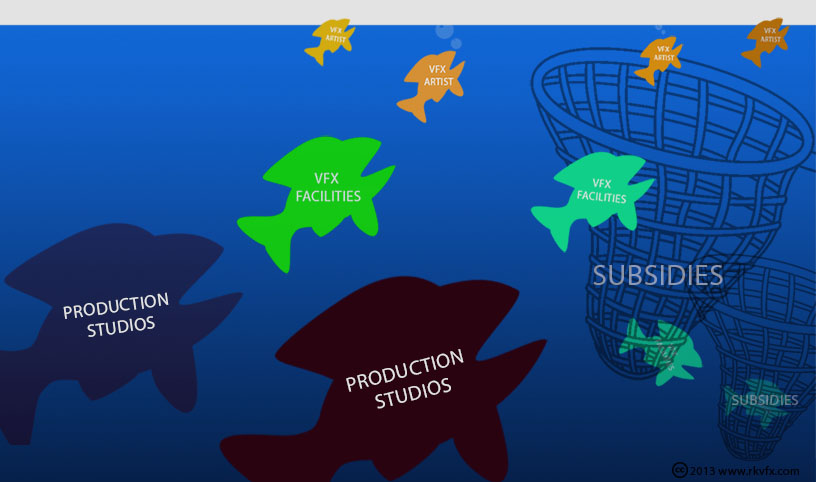
Big fish small fish VFX story

 It's been quite interesting times for global VFX for the past couple of weeks, though these are troubled times but it is much needed phase of industry which is getting matured. I think we have to wait and see how we going to come out of it and as usual stakes are always high for all the parties involved.   

The issue have got enough attention in all media and thanks to all the grass root movements such as VFX Soldier, VFX Solidarity and VFX tipping Point. Also worth mentioning exceptional individuals such as Scott Ross, Scott Squires, Dave Rand who are in forefront of these movement and put up the recent VFX Townhall Google Hangout on this issue. 


I think Scott Squires explained issue in a global perspective on the above video and it is really good see the issue taken up on an international perspective as the VFX is a global business now.

I think the key point here is the leverage of the production studios and the artists taking toll on the bottom the pyramid. It is crucial to note that cut-rate VFX will look shabby whether it's done in India, China or in US. The point is to stop cutting cost on the VFX and treat VFX as an actual production rather than a secondary service. I believe the production studios respect for VFX will make the directors and producer respect the VFX facilities which will in turn make the VFX facilities blossom and make room for VFX artists make a normal career out of this business.  

 I can't stress how important for all of us to realize that there is enough work for everybody and all the efforts should be put into developing this industry as whole rather than looking at local issues. 

Friday, August 3, 2012

Are you Purpose motive or Profit motive?

Well, the answer is quite easy as we need  both purpose and profit to motive us but I think the interesting fact here is that innovations happen only when we have a larger than life purpose in our lives. Sadly this concept of purpose motive is generally lacking mostly in our economy and society. I think only very few successful entrepreneurs like Steve Jobs gets it, after all money is not everything...

Enjoy the video :)

Tuesday, January 17, 2012

Douglas Trumbull & Miniatures Vs CG


A lot of movies made a few years ago don't look good today. They would never pass muster. But movies I've worked on using miniatures look good and don't age. If I did Blade Runner 2 today, I would use miniatures, even though I would use digital compositing and other digital effects far superior to optical printing.

Here is a two part interview at Creative Cow  where Trumbull discuss what keeps him busy these days. I quite well agree with his above statement and I believe above miniature in Blade Runner is one of the best sci-fi spectacle I have seen in films to date.

I truly hope and wish Trumbull will shift direction of VFX industry once again in near future. 

Tuesday, January 10, 2012

Classic multi plane matte shot

I came across another great post at Matte Shot - a tribute to Golden Era special fx and this photograph really made my day so I thought it would be worth putting here as reminder for myself.


This is kind of shot I do on day to day basis and it's great feeling to see people were doing this techniques of 2.5d or camera projection decades before computers were introduced to visual effects.

link to the blog post


Thursday, February 10, 2011

My favorite top 10 TED talks

I been watching TED talks ever since it went public on internet. Since I subscribe to their monthly newsletter I haven't really missed any of the popular talks. TED talks have been really inspiring and had a great influence on my life. Though I have constantly posted some of the talks in my blog but there are few talks which always come to my mind when I think about TED and following are some of those talks I would rate it as my favorites.


and this one is my most favorite!

Friday, January 7, 2011

Ken Robinson: Changing education paradigms

Sir Ken Robinson's talk never ceases to amaze me and I think he is absolutely right! We need a paradigm shift in our education system to change the way we think, work and live. Until then most of us will be stuck within our iterating factory line systems and unaesthetic minds.

Monday, October 25, 2010

Porn drives technology and its goes stereoscopic!

They say porn industry drives technology and it didn't took much time for them to join the new millennium's stereoscopic 3D bandwagon. According to a guardin article, in nutshell here is what porn has done for media industry so far.

· Camcorder and VHS video machines were pioneered by porn barons anxious to find a cheap way to mass market blue movies. Take-up of DVD players was driven by pornographers and their customers because the technology enabled users to skip to and from their favourite scenes.

· Pay-per-view cable or satellite TV movies entered the market only after porn firms introduced 'premium' services in hotels and on digital networks. Interactive television, common on digital sport channels, was developed by pornographers to allow users to focus on favourite actors and actresses.

· Internet use and e-business have been driven by smut. There are 80,000 adult websites, which generate annual profits of more than £1 billion - more than any other e-commerce sector.


Tuesday, September 21, 2010

Nic Marks: The Happy Planet Index

I have already posted two videos (Link1, Link2) on Happiness culture and here is another one from TED which is worth bookmarking here.

Hope these ideas will really influence our work place and society in future.

Stay Happy :)

Friday, July 23, 2010

VFX Outsourcing Scare

I been participating and following in lot of discussions (link1, link2, link3) on this matter mainly in VFXtalk forum. The above first link is dated back to 2007 and rest two are recent links. There are quite a lot of discussions happening within the industry and including recent VFX TownHall meeting which grabbed lot of attention in general media.

The reason for this post is that I have an alternative thought on this matter and I think death of outsourcing to India and China can only do good for them in long term. As of now these two big countries are madly serving west, not only in VFX but also in other areas like IT and BPO.

If for some reason one day, this whole outsourcing business comes to an end and all these Indian and Chinese businesses started to look into their own potential and start to create market for themselves then I think the possibilities are limitless for them . We should never forget how much the population of India and China constitutes the entire world population and also both these economies are growly at very high rates with no signs of slowing down.

I feel both India and China are too comfortable with serving western markets that they don't realize the potential of their own markets. Bottom line is that this outsourcing business is not only doing bad for west but also for the east.

Anyway I feel this whole outsourcing business is a cyclical phenomena. By that, I mean soon Indian or Chinese companies would be outsourcing to Philippines, Vietnam or buying out US companies. We shouldn't forget what happened to American brands like Jaguar , Land Rover and Hummer which were bought by Indian and Chinese companies. Same could happen with entertainment business as well. Already Indian companies like Prime Focus and Reliance have strong presence in Hollywood

The actual reason for this scare is overlooked most of the times. If you really study the trends then its obvious that it is the state of the industry not the outsourcing which creates all this emotional responses. This has been addressed by industry pioneer, Scott Ross in two fxguide podcasts. He not only mentions issues but also the solutions in the latest podcast. The first podcast is definitely worth your time and it is one of the best podcast I ever heard at fxguide.com

As a final note, I think we all like to live in our own mind bubble and we would like to ignore the changes happening around us but the time will make us adapt to the reality somehow.

A few alternative perspectives on this subject


VFX Solider, an entire blog dedicated to this issue

Wednesday, July 7, 2010

TED talk on Fractals

Seriously I am not sure why I constantly stumbled on things that I have posted here before. Anyway I am glad it happens and I always come across information that particularly interests me.

I had posted about Loren Carpenter's fractal algorithm last year and today I came across this wonderful talk by a mathematics legend Benoit Mandelbrot, who talks about fascinating fractals forms which can be found in plants, clouds, human body, painting, architecture, and even in finical statistics.

It is amazing to see forms that can be created in Adobe Photoshop or After Effects with few clicks have so much complexity yet simple and related to our universe in various ways.


Sunday, June 27, 2010

Another video on Happiness Culture

Well, I just came across this interesting talk by hotelier Chip Conley on happiness based business model. After my recent rambling on the same, I was very intrigued by this talk as well so as usualI am just bookmarking it here in my blog.

Friday, June 11, 2010

Another cool Pixar article

Its seems like I can't get enough of it... I just came across another cool article on Wired about the Pixar process and if you think I'm just obsessed with their success stories then take a look at this quote for instance.

“It’s important that nobody gets mad at you for screwing up,” says Lee Unkrich, director of Toy Story 3. “We know screwups are an essential part of making something good. That’s why our goal is to screw up as fast as possible.”

Wednesday, June 9, 2010

The Happiness Culture

I saw this cool article called "The Happiness Culture: Zappos Isn't a Company -- It's a Mission" on fastcompany.com. It is a very interesting article about the business culture at an e-commerce company called Zappos and it discusses ideas of CEO, Tony Hsieh who have wrote book on the same topic.

According to the article, here are there main core values of the company.
1. Deliver Wow Through Service
2. Embrace and Drive Change
3. Create Fun and a Little Weirdness
4. Be Adventurous, Creative and Open-Minded
5. Pursue Growth and Learning
6. Build Open and Honest Relationships with Communication
7. Build a Positive Team and Family Spirit
8. Do More with Less
9. Be Passionate and Determined
10. Be Humble

What really made me intriguing is that it's seems a lot similar to Pixar's culture which I discussed in one of my last posts. Apart from the above points they even have a similar training program for all staffs irrespective of the position when they join the company.

Here are few interesting quotes on Hsieh which I found personally interesting

"I think we're just at the beginning where companies are becoming more and more transparent whether they like it or not. People are becoming...just because the information is everywhere and it's pretty hard to control now. So I think moving forward it's going to be only the authentic companies or people can win because everyone else will eventually be outed."

"In the end, the culture is about more than money. "It's not me saying to our employees, this is where our culture is. It's more about giving employees permission and encouraging them to just be themselves."


"There's three types of happiness and really happiness is about being able to combine pleasure, passion, and purpose in one's personal life. I think it's helpful and useful to actually think about all three in terms of how you can make customers happier, employees happier, and ultimately, investors happier."

Take a look at the interview which this article was based on.


Sunday, May 16, 2010

Notes on Stereoscopic 3D

I been following this technology closely for more than a year now and I was convinced that this technology is going to be a game changer when I first heard that Avatar is going to be on 3D. A lot has been happening since Avatar came out and I think one of the crucial outcome was incursion of stereoscopic 3D into main stream broadcast media.

Singapore, as a highly techno friendly country, will be the first among the nations to do a nationwide 3D trial on the broadcast possibly on coming August. I think as for the HD wave it would be interesting to see when viewers will fully adopt this technology to broadcaster's standards. On the other side Samsung is widely promoting it's line of 3D capable TVs and aims to sell more than 2 million 3-D TVs this year and Panasonic has already came up with their affordable 3D productions gears for broadcasters. With all these vibes there is strong urge in the industry to produce more stereoscopic content for this new market that is ranging from music videos to military simulations.

Apart from all these general happenings it was very intriguing to dig deep into the technology itself and to see how it has transformed in the past few years. Stereoscopy is relatively a very old technology and people are being lured with this illusion since 1800s. I think most popular technology which we are all familiar with is Anaglyph Image where two images (left and right) are made up two colors (red and cyan) and superimposed to create illusion of stereoscopy when watched with same color coded glasses. Fortunately we have already come a long way from Anaglyph Images which caused motion sickness to us most of times.

According to Wikipedia, there are two technology for viewing stereoscopy images, mainly active and passive glasses. Active glasses technology needs an expensive wireless electronic glasses which is synced with the display screen and passive glasses uses polarizing filters on the projectors to project two images superimposed on to the screen. So for obvious reasons such as cost and practicality, Active glasses technology is moving more towards broadcast and PC gaming markets and passive glasses towards cinemas.

In cinemas, the most widely used technologies are by RealD and Dolby 3D. Both of them use slightingly different technology that falls under passive glasses technology. According to Wikipedia, The RealD Cinema system uses an electronically driven circular polarizer, mounted in front of the projector and alternating between left- and right- handedness, in sync with the left or right image being displayed by the (digital) movie projector.

Dolby 3D uses Infitec which stands for interference filter technology that splits the color spectrum into six narrow bands which then are divided into 2 in three primary color channels. This technology is a much superior form of Anaglyph technology.

There is also IMAX3D which use polarization technology similar to that of RealD.

As for a standardization, at the moment RealD is the clear winner in the race with the huge success of Avatar. According to Zdnet.com, the company has net loss of 16.3 million from 23.4 million revenue in the year 2008 and for the year end of 2009, the company lost 20.3 million from 95.9 million revenue. Here is an image comparing both Anaglyph and polarizertechnology.

On the other side, broadcast and PC Industry are widely embracing Active glasses or Liquid Shutter Glass technology. Like I mentioned before in this technique liquid crystals are triggered in synchronization with the refresh rate of the screen allowing the glasses to alternately darken over one eye, and then the other. Screens also display different perspective for each eye using a technique called Alternate frame sequencing.

Nvidia is in forefront of this technology along with Samsung in PC gaming market while Samsung plans to dominate broadcast market and others like Panasonic and Sony are joining the trend. All of them uses the same technique ofalternative frame sequencing or time sequencing as mentioned above. It is important note that most of today's screens or monitor's support maximum of 80 hertz refresh rate but in order to support this high speed syncing with the active shutter glasses the screen should have a minimum refresh rate of 120 hertz.

Following is a Panasonic promotional video showing previous technology and advantages of current technology

Panasonic has also offers full 3D solutions from production to delivery, take a look at below video below and here is the link to their full production flow chart.


There are also other technologies in which you don't have to wear any glasses. These technologies comes under the category of Autostereoscopy. Uptil now most of these technologies are expensive and screen based so it may not ne easily adoptable for cinemas or main stream broadcast. One such technique is Pixel barrier where two images (left and right) are interlaced into the screen simultaneously.

Another similar technology is Alioscopy, where you have pixel barrier or filter to make the coded sub pixels a stereoscopic 3D experience. The real beauty of this technology is that it has 8 different perspectives so viewer could enjoy the true 3D experience from different angles. I have personally experienced this technology and found it truly an amazing experiencing but at the same time rendering 8 different views in full HD resolution would be extremely time consuming process.

With all these happenings it is so obvious that a good part of futur entertainment is going to be on 3D. I feel it is crucial to note that even though Stereoscopic 3D is not a new technology but only until Avatar that James Cameron showed us that this technology could be effectively used as a visual language rather than just a gimmick to attract audience.

Unfortunately in case of the films, a lot of production houses are looking at it as marketing tool to attract audience rather than taking it as a story telling medium and I think in broadcast media, stereoscopy is pushed in order to resurrect the penetration of HD into the main stream market considering only two broadcasters worldwide are fully HD now. According to Bill Schultz, co-CEO of Moonsoop Entertainment, L.A., "We have been doing HD for six or seven years, and there are still broadcasters who do not ask for an HD delivery,". So if Stereoscopic 3D becomes successful at least it will make sure that everybody goes HD.

I could be completely wrong here but personally, I don't feel like looking at stereoscopy as a future but instead I would like to see it as matured form of story telling medium because lot of people associate it with black & white to color or silence to sound transition in films. But from what I have seen and experienced, I think this technology has it's limitations compared to conventional 2D films and there are times where 2D might win over 3D films. For example, fast cuts of shots with different scale and depth might work pretty well with the conventional 2D film. But I think doing that sort of cuts in stereoscopic film in which the perception of deptsh changes very quickly between scenes may not be pleasing to your brain no matter how good the edit looks.

Since doing a Stereoscopic film would be technically superior I think a good example to relate what I meant would be, painting with water color and oil paint. You could pain beautiful paintings with both mediums but oil painting add whole new demension as well as technical limiations compared to water color. So it just the choice of the filmmaker that would call for Stereoscopy.

Micheal Bay is one of the director is who has been outspoken about his opinion on 3D as well as 2D to Stereoscopic 3D conversion. Micheal Bay says “The way I shoot is too aggressive for 3D cameras. It’s a time consuming thing,” said Bay. “Who knows… It might be a fad. I’m kinda old school. I’m old school because I like to shoot on film. I like anamorphic lenses, and that is old school.” I agree with him on the above statement and I think it relates to my previous example as well.

For the past few weeks I been testing stereoscopy at my workplace, so I will try to post more on this subject relating to workflow, aesthetic and story tellings aspects as I discover them.

Sunday, May 9, 2010

Ed Catmull on rendering successful business


I stumbled upon this great talk by president of Pixar, Ed Catmull on maintaining successful creative environment. As an artist, personally I feel creating and sustaining a creative environment on workplace is the most crucial part of any art production. Art is all about expressing our emotions or ideas in such way that the audience feel and embrace it with their own collective experience. So if artists are working in an environment where they are intimidated by the managerial forces then it is merely impossible for them express their emotions or ideas.

I found issues raised by Catmull very intriguing and it made me dig more deep into more articles on Pixar's business model.

Later, I came across couple of other good articles and a great video interview of Catmull on The Economist. All of the articles I came across discussed the same issues he addressed in the first talk which is derived from his own tremendous experience in the computer graphics and animation industry.

One of the main point raised by Catmull was that lot of companies confuse the organisational structure with the communication structure which will hinder the creativity of the team. According to him flow of information between all the departments irrespective of structural management is must to facilitate a creativity. This is in very much contrast to the general idea of management where you report only to your manager or supervisor. But according to Catmull, the efficient way to manage people is to trust them and make them responsible for the work they do instead of getting permission from manager for each task.

He gives a good example on above issue in Harvard Business Review as follows, "Within Pixar, members of any department can approach anyone in another department to solve problems, without having to go through 'proper' channels. Managers understand they don't always have to be the first o know about something going on in their realm, and that it's okay to walk into a meeting and be surprised."

The above management philosophy goes together with the peer culture in Pixar which relays lot on trust and honesty. Since everyone have a shared responsibility and trust then it is easy to recover from a failure and Catmull stress that good management is not about preventing the errors but it is about recovering from the failures.

In order to facilitate communication, trust, high morale and spirit practically into work environment of Pixar, they have formulated Pixar University which trains employees at any level on general fine arts education. The classes are mainly on pushing unconventional thinking, creating peer culture and teamwork among the all levels of the company. According to Pixar University Dean Randy Nelson, "If you don't create an atmosphere in which risk can be easily taken, in which weird ideas can be floated, then it's likely you're going to be producing work that will look derivative in the marketplace."

It is very important to note that at Pixar they put more importance on people and workplace than the ideas they create. As Catmull says in the talk, if a good idea is given to a bad team they won't come up with anything but at the same time if the team was good then they would have either fixed it and or would have come up with a idea that works.

So it is very much crucial to put together teams of people to function well because because if they work well together then the ideas they created would sell anyway. The significance of people working together is so much important for Pixar because a movie was never about an idea but it was all about collective ideas from people working effectively in different disciplines and levels. So it makes perfect sense why they put so much money and effort into making the creative space for their artists.

Finally it is interesting to note that great art always comes from unstable environment and like Catmull points out in the above talk that good teams are inherently unstable. So much of what I discussed above goes to the fact that it is essential to have working environment which not only creates great ideas but keep people together and I hope people get that right and not just they get notion of it.

'The prhase is important in the community but it just doesn't have any effect on the behavior"
Ed Catmull