Tuesday, October 20, 2015
Sunday, August 9, 2015
Saturday, June 6, 2015
Wednesday, April 29, 2015
Fjords matte painting breakdown
Inspiration
My main source inspiration for this piece came from the The History channel series 'The Vikings'. I was really captivated by splendid scale of the fjords and I really wanted to capture sense of that vastness in the landscape.
As you can see sense of scale of these mountains are quite breathtaking and I wanted that to be the main focal point of this matte painting. I also took some color cues from the second screenshot. I really liked the earthly tones in the palette and I wanted to go for the same balance but with more warmer tones.
Conceptualization
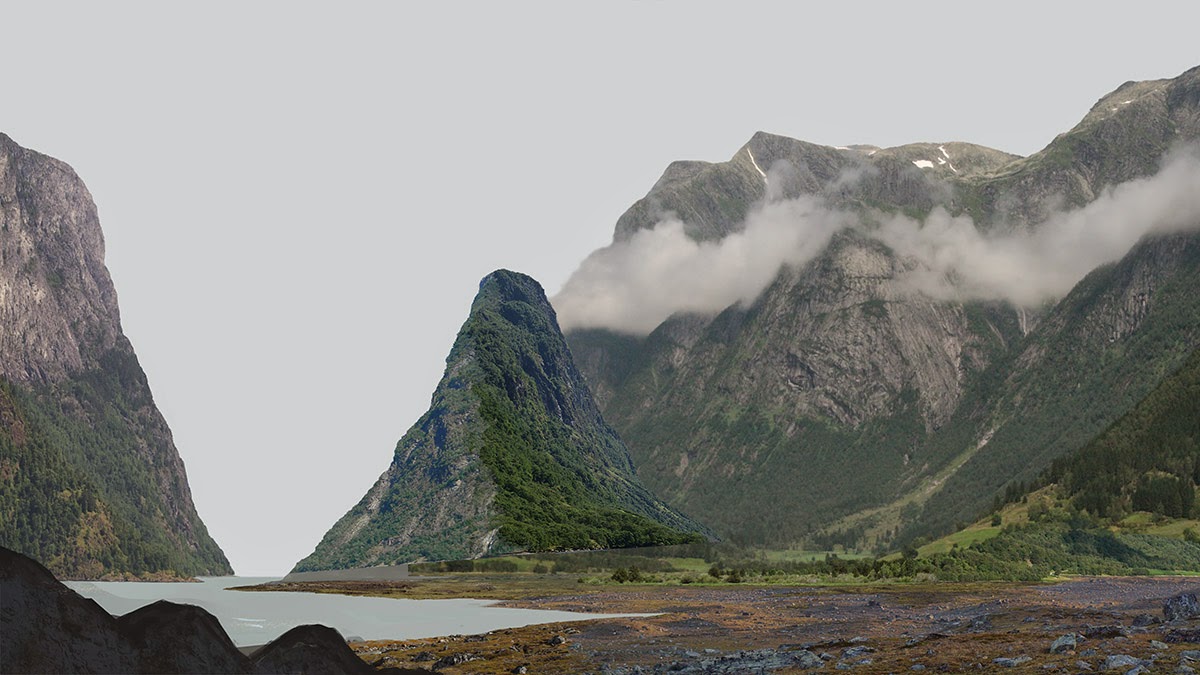
I started with a very loose value sketch blocking out my composition, scale and shapes. At this point, I wasn't sure about the final direction as I was still exploring different variations in scale and shapes. I wasn't keen on putting any details here as all of this will be replaced by different textures I would use from my photo references. It is a good idea to establish your light direction at this stage so it helps while you look for your photo references which you may use as textures to fill these shapes.
Photo References
This is most important part of digital matte painting and it might take lot of your time finding the right photos which can act as your textures. I always approach this from a set extension point of view. By that I mean, I will find a hero reference plate (photo) and use that as my main element and work my way from there. I think this method is very useful because most of the times in a production environment you would end up matching all your elements / textures to a particular shot plate (footage).
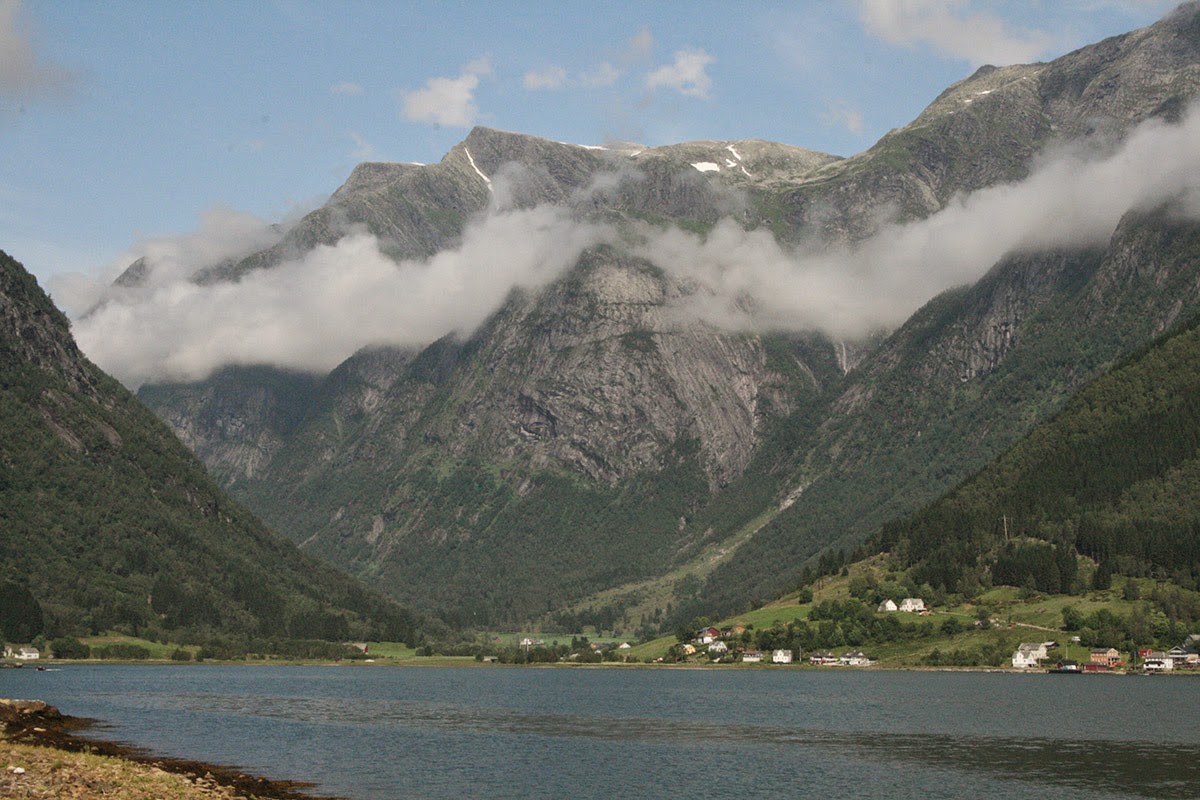
Hero plate

I really liked the sense of scale this photo and the clouds had a very surreal feel to it. And here is a collage of other main references I use for this matte painting.
Please note that I do not own copyrights for any of these images but I have made sure I have used them in a way that it is no longer fully or partially resembles it's original form. And since this is a non-commercial personal project I believe I am on the safe side. When you work on a commercial project, please do double check the copyrights of your photo references or make sure you use them as textures and make it unrecognizable.
Photo Collage and Image manipulation
I started building the matte painting by deriving different photo elements from the references I collected from Google Images and I used them as textures to fill up my concept sketch. It is very crucial to note that you have to keep the sense of scale, linear perspective and lighting uniform during this process.
At this stage, I realized I was not happy with the scale I was going after and I wanted to keep my matte painting close to photo realism so I decided to make minor changes to my initial concept sketch
As you can see now the composition is more relaxed and balanced. With most of my personal projects I keep experimenting with composition until the last moment. I don't get this luxury when I do freelance work or when I am on a contract job.
Above you can see, I brought in more rock elements for the foreground and I arranged them in such a way that it helps to lead the viewer's eye to my hero mountain. I made sure my rock elements were fitting into the scale and perspective. The most challenging aspect of this matte painting was getting scale right with all the elements.
Here is the final photo montage with sky and water. I usually work on the sky first as it plays huge role in defining the lighting of the scene but in this case I knew the kind of cloudy sky I was going after with hints of directional lighting so the sky came a bit late in the process.
Color balancing and lighting
Using adjustment layers, I have non-destructively color corrected all the layers to neutrally balance their colors to the main hero element. The step below is where I have spent most of my time in this matte painting. I have used adjustment layers and hand painting techniques to add lighting, shadows and better integration for the elements. Below you can see I have moved towards more earthly color tones matching to my inspiration references.
Atmosphere, Lighting and Finishing
In the final stage I have worked more on the atmosphere, lighting and refining the elements especially on the foreground. I would say the most time consuming process was the beginning and finishing stage since I have to finalize and make decisions on every minute details.
I hope you enjoyed the breakdown, please feel free to comment here or ask any questions.
Cheers,
Rahul
Sunday, February 8, 2015
Vancouver
This week I also noticed REDHOT VFX has posted a glimpse of what I worked for them during last year, you can check out the video here and here is couple of screenshots.
DMP
Final Comp
Saturday, December 20, 2014
Saturday, September 27, 2014
Thursday, September 25, 2014
Saturday, July 26, 2014
Thursday, June 5, 2014
Monday, April 28, 2014
London Calling
Tuesday, January 21, 2014
Mountains sunset
(update, here is another version. Thanks Faisal for the comments)
Hope you guys like it :)
Rahul
Friday, January 10, 2014
The Great Indian Creative Dilemma
According to various estimates, around 1.5 million engineering graduates emerge from India each year—significantly more than many Western countries, including the U.S. Yet, India is still struggling to make a lasting global impact when it comes to innovative products or services.
And this isn’t limited to the tech sector. It’s even more apparent in inherently creative industries like film, animation, and architecture.
Having worked in the film and commercial industries across five countries, including India, I’ve seen this issue up close. The difference isn’t talent—we have that in abundance. The difference lies in culture and mindset.
Entrepreneurship Is Growing, But Innovation Still Lags
Yes, India has seen a steady rise in entrepreneurship over the years. But innovation—true, game-changing innovation—is still rare.
At the root of this are two key issues:
-
Our education system, which often discourages curiosity and exploration.
-
Our cultural values, which reward obedience over questioning.
We build our values on fixed dogmas, but the world around us is rapidly evolving—interconnected, transparent, and open. In such a world, lacking a creative culture leads to mediocrity. Only businesses that offer authentic solutions will survive.
Innovation today isn’t just about great ideas—it’s about redefining economic value and shifting consumer mindsets. Companies like Apple have understood this for decades and built their core culture around it.
We have the talent, the infrastructure, and the potential. What we need is an environment that nurtures creativity.
Hierarchy: The Silent Killer of Creativity
One of the biggest blockers of creativity in India is the rigid hierarchy in workplaces.
Drawing from our cultural values, people are often afraid to speak up to someone above them. This suppresses the creative flow of ideas and encourages people to play it safe. Over time, this results in mediocrity, and our ability to compete at global standards weakens.
Creativity thrives on open communication and psychological safety. When team members feel safe, ideas flow. When they feel judged or silenced, innovation stops.
Leadership plays a critical role here. It’s not about control, but about creating space—loosening the reins, not tightening them.
At Pixar Animation Studios, for instance, Ed Catmull, President of Pixar, shares:
“Within Pixar, members of any department can approach anyone in another department to solve problems, without having to go through ‘proper’ channels. Managers understand they don't always have to be the first to know about something going on in their realm, and that it's okay to walk into a meeting and be surprised.”
Our Fear of Failure Holds Us Back
Another cultural roadblock to creativity in India is our attitude towards failure.
We stigmatize failure. We hide it. We rarely analyze it. And as a result, we don’t learn from it.
But failure is essential to innovation. Every breakthrough idea is the result of multiple failures and iterations.
We need to build a culture where failure is treated as a step forward—not a dead end. A place where people are trusted to experiment, take risks, and recover when things don’t work.
As William L. McKnight, former President and Chairman of 3M, once said:
“Management that is destructively critical when mistakes are made kills initiative. And it's essential that we have many people with initiative if we are to continue to grow.”
Creativity Can’t Be Controlled—But It Can Be Encouraged
If we want to push innovation beyond the usual boundaries of functionality and design, we need to let go of control.
Yes, that sounds risky. But great teams are often unpredictable by nature.
You can’t force creativity. You can only provoke it—by creating the right environment.
That means encouraging:
-
Radical thinking
-
Freedom of speech
-
Cross-functional collaboration
-
Constructive criticism
-
Playfulness and fun
-
Risk-taking (with support)
Companies like Google famously allow employees to spend 20% of their time on personal innovation projects. 3M did it before them, with their “15% rule” and even an “Innovator Award” for employees who created profitable ideas during that free time.
In India, Tata Group’s Innovista program is a great example of homegrown innovation culture. According to Sunil Sinha, Chief of Group Quality at Tata Sons:
“Tata Innovista has become a great indicator of the success of the innovation drive in the Tata group — and of the inherent capabilities of its people. The trends observed in the 2013 edition signify a growing culture of innovation in the group with elements of technology-orientation, cross-pollination, and risk-taking ability.”
It’s About People, Not Just Outcomes
Creative work culture isn’t about short-term goals or fast results. It’s about the process and people.
If companies build strong, well-functioning teams and give them a creative platform, the products and services will follow naturally.
As Tony Hsieh, the late CEO of Zappos and author of Delivering Happiness, put it:
“It’s not me saying to our employees, this is where our culture is. It’s more about giving employees permission and encouraging them to just be themselves.”
A truly creative workspace is about making the day-to-day experience fulfilling. It should value:
-
Employee well-being
-
Shared ownership
-
Mutual respect
-
Love for the work itself
In Conclusion
I believe all humans are inherently creative. But in India, due to cultural and social conditioning, that creativity often needs to be reawakened.
We need to create spaces—schools, offices, studios—where curiosity is encouraged, risk is supported, and diverse voices are heard.
Let me end with one final quote from Ed Catmull:
“The phrase is important in the community, but it just doesn't have any effect on the behavior.”
It’s not enough to say we value creativity—we have to live it.
Monday, December 30, 2013
Monday, December 2, 2013
Paul Debevec keynote talk at Smithsonian X 3D conference
Sunday, November 3, 2013
Wednesday, October 30, 2013
Concept video - Goldfish, a wish out of water
"Well, we are fish swimming in consciousness; and yet we know it's there. Well, the reason we know it's there is because if you perturb it, then you see it"
Sunday, October 20, 2013
Octhorber campaign promo for Disney XD channel
A screenshot from the final comp by Faisal
matte paintings
Monday, September 30, 2013
Comp reel 2013
reel2013 comp reel from Rahul on Vimeo.
I have updated the matte painting portfolio section with couple of commercials work I have done and I will be adding more in this section from the freelance work I been doing recently.
http://www.rkvfx.com/#!mattepainting/c199t
Sunday, September 8, 2013
Some classic examples of Rear Projection Matte painting techniques
Click here to watch the video in viemo